Artificial Intelligence is everywhere today. It is in the apps we use, the search engines we depend on, the recommendation systems we trust, the medical tools doctors are beginning to adopt, and the automation systems businesses are trying to build.
But there is one problem I see again and again.
Most people use AI, Machine Learning and Deep Learning as if they mean the same thing.
They are connected, but they are not the same.
As someone working across AI systems, STEM education, digital transformation and research, I strongly believe one thing:
Foundations matter more than buzzwords.
Tools will keep changing. Frameworks will keep changing. Models will keep changing. But the core principles of learning, data, optimization and system design will continue to remain important.
If we understand the concepts clearly, we can build better systems, ask better questions, and use AI more responsibly.
AI vs Machine Learning vs Deep Learning: The Simple Roadmap
Here is the simplest way to understand the relationship:
- Artificial Intelligence (AI) is the larger vision.
- Machine Learning (ML) is how systems learn patterns from data.
- Deep Learning (DL) is how neural networks learn complex patterns from images, audio, text and real-world signals.
In short:
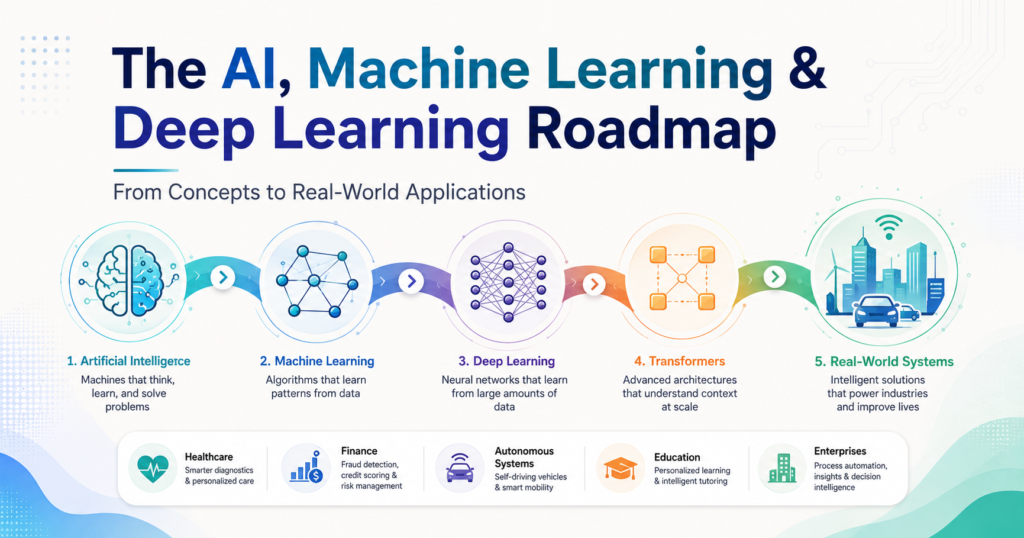
AI → Machine Learning → Deep Learning → Transformers → Real-world intelligent systems
This roadmap helps students, professionals, founders and educators understand how the field grows from basic concepts to practical applications.
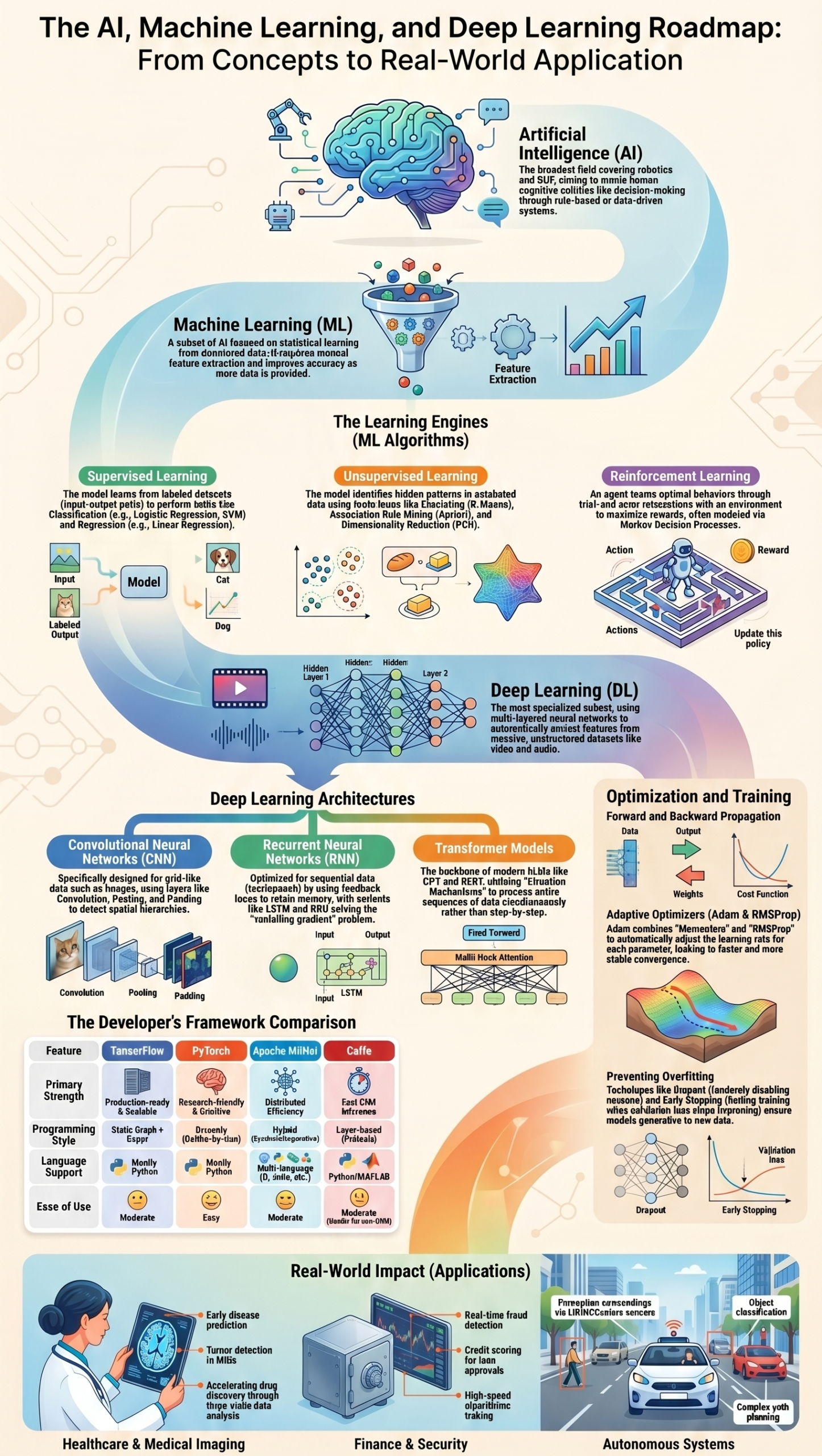
1. What is Artificial Intelligence?
Artificial Intelligence is the broader field of building systems that can perform tasks that usually require human intelligence.
These tasks may include understanding language, recognizing images, making decisions, planning actions, solving problems or interacting with humans.
Examples of AI include:
- Chatbots and virtual assistants
- Recommendation systems
- Autonomous vehicles
- Robotics systems
- Fraud detection systems
- AI-based medical diagnosis tools
AI is the umbrella term. Machine Learning and Deep Learning are important parts of this umbrella.
2. What is Machine Learning?
Machine Learning is a subset of AI where systems learn from data instead of being explicitly programmed for every possible situation.
In traditional programming, we write rules and the computer follows them. In Machine Learning, we provide data, and the system learns patterns from that data.
For example, instead of manually writing thousands of rules to identify whether an email is spam, we can train a Machine Learning model using examples of spam and non-spam emails.
The more relevant and high-quality data the model sees, the better it can become at making predictions.
3. What is Deep Learning?
Deep Learning is a specialised branch of Machine Learning that uses multi-layer neural networks to understand complex data.
Deep Learning is especially useful when we are working with unstructured data such as:
- Images
- Audio
- Video
- Natural language text
- Sensor data
- Complex real-world signals
This is why Deep Learning is widely used in face recognition, speech recognition, medical imaging, language translation, autonomous driving and Large Language Models.
4. The Learning Engines of Machine Learning
Machine Learning systems usually learn in three major ways: supervised learning, unsupervised learning and reinforcement learning.
Supervised Learning
In supervised learning, the model learns from labelled data.
For example, if we give the model many images labelled as “cat” or “dog”, it learns to classify new images into the correct category.
Common applications include:
- Email spam detection
- Credit scoring
- Image classification
- Disease prediction
- Customer churn prediction
Unsupervised Learning
In unsupervised learning, the model works with unlabelled data and tries to find hidden patterns or groups.
For example, a business may use unsupervised learning to group customers based on behaviour, even if those groups were not defined earlier.
Common applications include:
- Customer segmentation
- Market basket analysis
- Anomaly detection
- Document clustering
- Pattern discovery
Reinforcement Learning
In reinforcement learning, an agent learns by interacting with an environment and receiving rewards or penalties.
This is similar to how a player improves in a game by trying actions, seeing outcomes and adjusting strategy.
Common applications include:
- Game-playing AI
- Robotics
- Autonomous systems
- Dynamic pricing
- Resource optimization
5. Deep Learning Architectures You Should Know
Deep Learning uses different types of neural network architectures depending on the type of problem being solved.
Convolutional Neural Networks (CNNs)
Convolutional Neural Networks are commonly used for image-related tasks.
They are designed to detect patterns such as edges, shapes, textures and objects in images.
Common CNN applications include:
- Medical image analysis
- Object detection
- Face recognition
- Defect detection in manufacturing
- Satellite image analysis
Recurrent Neural Networks (RNNs)
Recurrent Neural Networks are designed for sequential data.
They were widely used for language, time-series and speech-related tasks before Transformer models became dominant.
Common RNN applications include:
- Speech recognition
- Time-series forecasting
- Text generation
- Language modelling
- Sentiment analysis
Transformer Models
Transformer models are the backbone of modern Large Language Models and many Generative AI systems.
Transformers use attention mechanisms to understand relationships between different parts of the input. This makes them powerful for language, code, image-text reasoning and multimodal AI systems.
Common Transformer applications include:
- Large Language Models
- Chatbots
- Translation systems
- Document summarization
- Code generation
- Multimodal AI applications
6. Training Concepts: How Models Improve
Training a model is not magic. It is an optimization process.
The model makes predictions, compares them with expected results, calculates error and adjusts internal weights to improve future predictions.
Some important training concepts include:
- Forward Propagation: Data moves through the network to produce an output.
- Backpropagation: The model calculates how much each weight contributed to the error.
- Optimization: Algorithms adjust weights to reduce the error.
- Regularisation: Techniques used to prevent the model from memorising instead of learning.
- Overfitting Prevention: Methods that help the model perform well on new, unseen data.
Once you understand these concepts, Deep Learning becomes less mysterious and more engineering-oriented.
7. Real-World Applications of AI, ML and Deep Learning
The real power of AI is not in the buzzwords. It is in solving real human and business problems.
Healthcare and Medical Imaging
AI and Deep Learning can help doctors identify patterns in medical scans, detect early signs of disease and support faster diagnosis.
Examples include tumour detection, early disease prediction and medical image classification.
Finance and Security
Machine Learning is widely used in finance for fraud detection, credit scoring, algorithmic trading and risk assessment.
Security systems also use AI to identify anomalies, suspicious behaviour and potential threats.
Autonomous Systems
Autonomous systems use AI to sense the environment, make decisions and take action.
This includes self-driving cars, drones, warehouse robots and intelligent navigation systems.
8. Why This Roadmap Matters
If students, professionals and founders understand this roadmap clearly, they can stop treating AI as magic and start using it as a serious engineering and problem-solving discipline.
This is the real shift we need.
- Students can build stronger fundamentals before jumping into tools.
- Professionals can understand where AI fits into their work.
- Founders can make better product and technology decisions.
- Educators can explain AI without turning it into hype.
AI is not just about using the latest model. It is about understanding data, learning, optimization, architecture and application.
Final Thought
AI will continue to evolve rapidly. New tools, frameworks and models will keep appearing.
But the foundation remains the same:
Focus on concepts. Understand them deeply. Build upon them responsibly.
That is how we move from buzzwords to real-world impact.
You can also connect this blog with related future articles such as:
- AI Concepts Simplified: How Large Language Models Work
- Training vs Inference in AI
- Backpropagation Simplified for Beginners
- How AI Can Be Used in Education and STEM Learning
What Should I Simplify Next?
In the next post, I can simplify one of these topics:
- Training vs Inference
- CNNs vs RNNs vs Transformers
- Backpropagation Simplified
- How Large Language Models Actually Learn
- AI Use Cases in Education and Industry
If you are a student, educator, founder or professional exploring AI, this roadmap is a good place to begin.
Frequently Asked Questions
What is the difference between AI, Machine Learning and Deep Learning?
Artificial Intelligence is the broader field of building intelligent systems. Machine Learning is a subset of AI where systems learn from data. Deep Learning is a specialised branch of Machine Learning that uses neural networks with multiple layers to learn complex patterns from data.
Is Deep Learning better than Machine Learning?
Deep Learning is not always better. It is powerful for complex data such as images, speech, video and natural language. For smaller datasets or simpler problems, traditional Machine Learning methods may be faster, easier and more practical.
Why are Transformers important in AI?
Transformers are important because they use attention mechanisms to understand relationships between different parts of data. They are the foundation of many modern Large Language Models, chatbots, translation systems and Generative AI tools.
What should beginners learn first in AI?
Beginners should first understand data, basic programming, probability, statistics, Machine Learning concepts and model evaluation. After that, they can move toward neural networks, Deep Learning and Transformer models.
Tags: AI, Machine Learning, Deep Learning, Artificial Intelligence, Neural Networks, Transformers, Data Science, EdTech, STEM, Digital Transformation, SkillUp Circle, SkillUp Ventures